
Trial Site Density as an Early Commercial Signal
Recruiting Phase 3 cancer trials that gate eligibility on a biomarker list 92 sites on average against 39 for those that do not, an early read on testing demand.
 By Peleg Chevion, Managing Partner
10 min read · Life Sciences and Healthcare
By Peleg Chevion, Managing Partner
10 min read · Life Sciences and Healthcare
In this note06 · 10 min
Recruiting Phase 3 cancer trials whose eligibility criteria name a biomarker list 92 sites on average, against 39 for trials that name none, and the gap holds inside industry-sponsored work (a median of 46 sites against 21). Every listed site in a marker-gated trial must obtain a test result before it can enroll a patient, which makes site density an early, public read on where diagnostic testing demand will form.
01The Measurement
The dataset comes from ClinicalTrials.gov, the federal registry through which the National Institutes of Health administers the registration rules of 42 CFR Part 11, queried through its public REST API, version 2.0.5. The registry snapshot carries the data timestamp October 9, 2026, as reported by the API's version endpoint, and the queries were run on October 11, 2026. Every figure on this page can be reproduced from the parameters below against that endpoint.
The universe is every interventional, Phase 3, currently recruiting trial that the registry associates with cancer. The request to /api/v2/studies uses four parameters:
- query.cond=cancer, the condition search, which applies the registry's synonym expansion (cancer, neoplasm, carcinoma and related terms);
- filter.overallStatus=RECRUITING;
- filter.advanced=AREA[Phase]PHASE3 AND AREA[StudyType]INTERVENTIONAL, written in the registry's Essie expression syntax;
- fields=NCTId,LeadSponsorName,LeadSponsorClass,StartDate,LocationCountry,LocationState,LocationStatus, with pageSize=1000 and pageToken paging until no token is returned.
That request returns 1,566 trials. The Phase 3 filter also captures the 256 trials registered as combined Phase 2/Phase 3. Each eligibility cohort adds one clause to the front of filter.advanced, in the form AREA[EligibilityCriteria]<expression> AND, with these ten expressions:
- EGFR: ("EGFR mutation" OR "EGFR mutations" OR "EGFR mutant" OR "EGFR mutated" OR "EGFR or ALK" OR "EGFR ALK" OR "EGFR sensitizing" OR "EGFR exon" OR "EGFR alteration" OR "EGFR alterations" OR "EGFR TKI" OR "EGFR tyrosine")
- ALK: ALK
- KRAS: KRAS
- BRAF: BRAF
- HER2: HER2
- BRCA1/2: (BRCA OR BRCA1 OR BRCA2)
- ESR1: ESR1
- PD-L1: "PD-L1"
- MSI-H / dMMR: ("microsatellite instability" OR "mismatch repair" OR "MSI-H" OR dMMR)
- ctDNA: (ctDNA OR "circulating tumor DNA")
Site density is the count of facility records in each trial's location module, the data element that 42 CFR 11.28(a)(2)(iii)(C) requires as "Facility Information" for applicable clinical trials. A site listing is counted once per facility record. The United States share is the fraction of those records whose country field reads "United States." A trial is industry-led when its lead sponsor class is INDUSTRY.
The eligibility search counts a marker whether it appears as an inclusion criterion or an exclusion criterion. That is deliberate. A trial that admits only EGFR-mutant patients and a trial that excludes them both require the enrolling site to know the patient's EGFR status, so both put a test in front of enrollment. The EGFR expression is a phrase list rather than the bare token because the registry's search is case-insensitive: a bare EGFR query in this universe returns 202 trials, including a melanoma trial and a prostate cancer trial whose criteria refer to eGFR, the estimated glomerular filtration rate. The phrase list returns 74 trials, of which 71 list a lung cancer condition.
LeverVenture recomputes these figures each quarter from the same parameters and republishes them on this page, with the registry data timestamp of each run.
02Site Density by Eligibility Gate
The table reports, for each gate, the number of trials, the total facility listings, the mean and median listings per trial, the share of trials listing 50 or more sites, the United States share of listings and the share of trials led by industry. The groups overlap, because a lung cancer trial that names EGFR, ALK and PD-L1 counts in all three, so the marker rows do not sum to the "any" row.
| Eligibility gate | Trials | Site listings | Mean sites per trial | Median sites per trial | Trials with 50+ sites | U.S. share of listings | Industry-led |
|---|---|---|---|---|---|---|---|
| ESR1 | 33 | 6,513 | 197.4 | 21 | 48.5% | 74.3% | 45.5% |
| KRAS | 49 | 6,230 | 127.1 | 46 | 46.9% | 30.1% | 81.6% |
| BRCA1/2 | 39 | 4,599 | 117.9 | 31 | 46.2% | 41.8% | 59.0% |
| ctDNA | 23 | 4,492 | 195.3 | 22 | 43.5% | 83.0% | 17.4% |
| ALK | 84 | 10,977 | 130.7 | 32.5 | 39.3% | 55.2% | 56.0% |
| BRAF | 61 | 6,963 | 114.1 | 22 | 37.7% | 54.8% | 65.6% |
| PD-L1 | 213 | 23,396 | 109.8 | 12 | 35.2% | 46.1% | 53.1% |
| EGFR | 74 | 9,659 | 130.5 | 11 | 35.1% | 63.1% | 55.4% |
| HER2 | 213 | 21,412 | 100.5 | 4 | 33.3% | 49.6% | 50.2% |
| MSI-H / dMMR | 63 | 5,638 | 89.5 | 4 | 28.6% | 64.2% | 41.3% |
| Any of the ten | 537 | 49,526 | 92.2 | 7 | 33.3% | 47.4% | 51.2% |
| None of the ten | 1,029 | 40,291 | 39.2 | 3 | 20.2% | 44.4% | 31.2% |
| All trials in the universe | 1,566 | 89,817 | 57.4 | 4 | 24.7% | 46.1% | 38.1% |
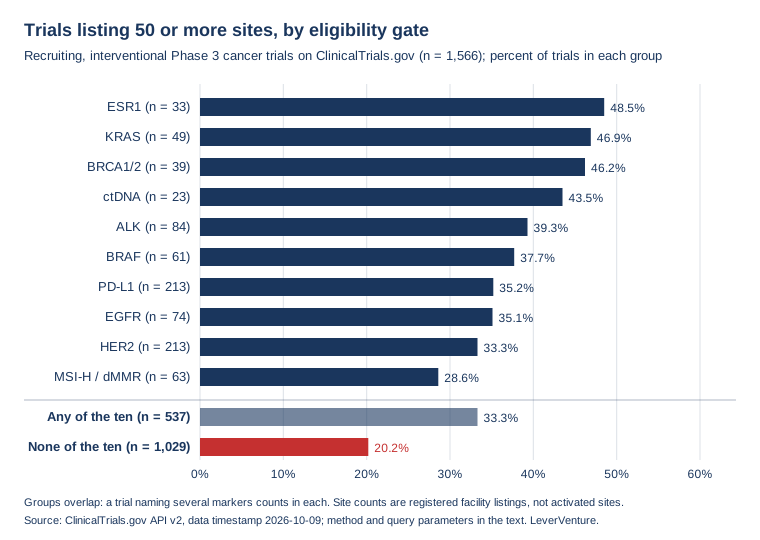
The pooled comparison overstates the effect, because marker-gated trials are more often led by industry (51.2% against 31.2%), and industry trials run larger networks for reasons unrelated to biomarkers.
The cleaner comparison holds sponsor class fixed. Among the 596 industry-led trials in the universe, the 275 that name one of the ten markers list a median of 46 sites and a mean of 112.0, and 49.1% of them list 50 or more. The 321 industry-led trials that name none list a median of 21 sites and a mean of 64.5, and 38.6% list 50 or more. A sponsor that gates enrollment on a marker builds a wider network, plausibly because a marker-defined population is a fraction of the disease population and more sites are needed to find it.
03Sponsor Class and the Single-Site Trial
The distribution is heavily skewed, which is why the universe median is 4 sites while the mean is 57.4. Of the 1,566 trials, 643 (41.1%) list exactly one facility. Most of these are investigator-initiated studies led by a hospital or university, the registry's OTHER sponsor class, whose 843 trials have a median of one listed site. A single-site Phase 3 is a legitimate study, but it says nothing about a commercial footprint, and it pulls every pooled median toward zero. For that reason, the share of trials above 50 sites and the within-sponsor medians carry more information than the pooled median.
At the other end sit the publicly funded cooperative groups. The 20 trials whose lead sponsor class is NIH list a median of 294.5 sites, and 98.9% of their listings are in the United States. The 67 trials in the NETWORK class list a median of 87 sites, 89.9% of them in the United States. Industry-led trials, by contrast, place only 23.0% of their 51,485 listings in the United States and a median of three countries per trial. United States facilities account for 46.1% of all listings in the universe (41,390 of 89,817), and a large part of that share is the cooperative-group system.
That system reaches beyond academic centers. The National Cancer Institute describes its National Clinical Trials Network as covering more than 2,200 sites across the United States, Canada and internationally, with community hospitals taking part directly or through the NCI Community Oncology Research Program, which brings trials to patients in their communities. Two network studies in the dataset show the scale. The Lung-MAP screening protocol, a SWOG master protocol for biomarker-driven therapies in previously treated non-small cell lung cancer, lists 1,229 facilities. An NRG Oncology colon cancer trial that assigns adjuvant chemotherapy according to a residual-disease blood test lists 1,077.
The ctDNA row reflects the same pattern. Trials whose eligibility turns on circulating tumor DNA list a mean of 195.3 sites, 83.0% of the listings are in the United States, and only 17.4% of those trials are industry-led. Residual-disease testing is being validated in large part through publicly funded networks that reach community oncology practices, rather than through drug sponsors' registration programs.
04From Enrollment Site to Testing Demand
A marker gate converts every activated site into a testing node. The specimen has to be collected, routed and reported, and the report has to reach the investigator before randomization. Under the Clinical Laboratory Improvement Amendments regulations, a laboratory is any facility that examines human specimens to provide information for the diagnosis, prevention or treatment of disease (42 CFR 493.2). The research-laboratory exception in 42 CFR 493.3(b)(2) covers only laboratories that do not report patient-specific results for diagnosis, prevention or treatment. A marker result that decides whether a patient enters a treatment arm is reported for exactly that purpose, so enrollment testing generally runs in CLIA-certified laboratories, whether a central laboratory or the site's own.
The drug-side framework tightens the link. FDA's final guidance, In Vitro Companion Diagnostic Devices (August 6, 2014), defines a companion diagnostic as an in vitro diagnostic device that provides information essential for the safe and effective use of a corresponding therapeutic product, with its use stipulated in the labeling of both the device and the drug.
Section VI of the guidance states that when an investigational diagnostic is used to make critical treatment decisions such as patient selection, it generally will be considered a significant risk device under 21 CFR 812.3(m)(3), and its sponsor must comply with the investigational device exemption regulations. The drug and the test can be studied in the same trial if it satisfies both Part 812 and the investigational new drug regulations.
The 2025 litigation over laboratory-developed tests did not change that framework. FDA's laboratory-developed tests page records that a federal district court vacated the agency's May 2024 final rule on March 31, 2025, and that FDA issued a final rule on September 19, 2025, reverting the regulation to its prior text. The companion diagnostic guidance remains listed as final. A laboratory's status as an LDT developer therefore does not settle whether its assay, used to select patients in a drug trial, is an investigational device.
The commercial reading follows. Each of the nine gene and protein markers in the table appears in indications on FDA's list of authorized companion diagnostic devices, so the pattern from gated trial to labeled test is established, not speculative.
When a marker-gated drug is approved with a companion diagnostic, the sites that enrolled patients have already built the ordering habit, the specimen workflow and the pathology turnaround the label will require. The number and geography of those sites, read while the trial is still enrolling, indicate how broad the initial testing footprint will be and where it will concentrate. A diagnostics company whose assay is the enrollment test inside a 300-site trial is building a referral network that a company selling into the same indication after approval has to build from nothing.
The registry does not say which laboratory runs the enrollment test. A trial that routes every specimen to one central laboratory concentrates volume in that laboratory and teaches sites only to ship samples, while a trial that accepts local results spreads both volume and familiarity across site laboratories. The protocol and the laboratory manual settle the question, and for a diagnostics investment it is the first one to ask once site density has identified the trials that matter.
05Limits of the Signal
A facility listing is a registration record, not an activated site. Of the 89,817 listings in the universe, 77.9% carry a recruiting status, 8.8% are not yet recruiting, 5.8% are active but not recruiting, 3.8% are suspended and 2.0% are withdrawn. Federal rules require the responsible party for an applicable clinical trial initiated on or after January 18, 2017 to update each individual site's status within 30 calendar days of a change, under 42 CFR 11.64(a)(1)(ii)(G). Trials outside that definition, including many conducted entirely outside the United States, register voluntarily or under other regimes, and their location records can lag.
The eligibility search is lexical. It finds the word, not the criterion, and the EGFR example shows how a common abbreviation collides with an unrelated laboratory value. Any automated pipeline that screens registry text for markers, including machine-learning classifiers, needs term-level validation against a sample of records before its counts are trusted, which is the same demand for validation on data the model was not built on that AI diligence makes of a company's model claims. Condition synonym expansion also admits a small number of records whose listed conditions are not cancers; the counts here are left as the registry returns them so that they reproduce exactly.
Density measures breadth, not productivity. A trial with 300 listed sites may enroll most of its patients at 30 of them, and the registry carries no per-site enrollment. The measure also says nothing about whether the drug will succeed. It identifies where testing infrastructure is being built now; whether that infrastructure becomes a commercial market depends on the trial readout, the label and coverage.
06Frequently asked questions
What does trial site density measure?
It is the number of facility records a trial lists on ClinicalTrials.gov. It measures the breadth of the network a sponsor has registered to recruit patients. It does not measure how many sites are activated or how many patients each site enrolls, and a listing can carry a not-yet-recruiting, suspended or withdrawn status.
Why does a biomarker in eligibility criteria matter to a diagnostics company?
A trial that includes or excludes patients by a marker cannot enroll anyone until the site has that patient's result. Each site therefore builds the specimen workflow and ordering habit that a companion diagnostic label later requires, and FDA's 2014 guidance treats a test used for patient selection in a trial as generally a significant risk investigational device.
How can the figures on this page be reproduced?
Send the listed parameters to the ClinicalTrials.gov API version 2 studies endpoint, page through the results, and count the location records per trial. Results will move as the registry updates, so compare against the data timestamp reported by the API's version endpoint at the time of the query.
Nothing in this piece is investment, legal, tax or accounting advice, and nothing in it is an offer to sell or a solicitation of an offer to buy any security.
Three decades of operational leadership across agriculture, pharmaceuticals, biotechnology, climate, food and defense. He has spent that career doing the work this seat requires: strategic partnerships, licensing and business development, executed transaction by transaction. He sits with a company as an operating partner and a growth strategist rather than as a name on its board. A corporate finance and intellectual property attorney, an INSEAD MBA, and a former Air Force officer in aerospace. He also brings strong private equity experience.
Want to discuss this note or have questions? We would be glad to hear from you.