
Carried Interest: European and American Waterfalls, Side by Side
On one hypothetical $100 million fund, a deal-by-deal waterfall pays $15 million of carry by year three and a whole-of-fund waterfall pays $10 million. A clawback closes the gap.
 By Peleg Chevion, Managing Partner
11 min read · Growth Equity
By Peleg Chevion, Managing Partner
11 min read · Growth Equity
In this note06 · 11 min
On one hypothetical $100 million fund with identical terms, a deal-by-deal (American) waterfall pays the general partner $15,000,000 of carried interest by the end of year three, $8,000,000 of it in year two. A whole-of-fund (European) waterfall pays $10,000,000, all in year three. When the last investment is written off, the $5,000,000 difference reaches limited partners only through a clawback.
The headline economics are the same in both cases: the same preferred return, the same catch-up and the same 20 percent share of profit. What differs is the unit on which profit is measured. A whole-of-fund waterfall measures it once, across the portfolio. A deal-by-deal waterfall measures it at each sale, before the rest of the portfolio has been tested. That difference decides when the general partner is paid, how much is at risk of being overpaid, and which contract terms carry the protection.
01The Two Structures
The Institutional Limited Partners Association (ILPA) publishes a model limited partnership agreement in both forms. The whole-of-fund term sheet sets four tiers: 100 percent to the limited partner until it has received its aggregate capital contributions; then 100 percent until it has received its preferred return; then a catch-up split 80 percent to the general partner and 20 percent to the limited partner until the general partner holds 20 percent of the profit distributed; and then 80/20 thereafter. The rates sit in brackets, which marks them as negotiable placeholders.
The deal-by-deal term sheet runs the same four tiers on the proceeds of each portfolio investment. Its first tier is wider than its name suggests: before any preferred return or carry, the limited partner must receive the capital used to fund the investment being sold, every previously realized investment, aggregate unrealized losses, and fund expenses including the management fee. A deal-by-deal waterfall written to that standard is materially tighter than the textbook version, which returns only the cost of the deal in hand.
The labels describe structure, not the manager's location. The European waterfall calculates carry at the fund level across all deals; the American waterfall calculates it deal by deal and often lets the general partner begin taking carry earlier in the life of the fund (iCapital).
Market practice favors the whole-of-fund form. ILPA's 2021 report What is Market in Fund Terms?, drawing on a Colmore data set of 695 agreements, found whole-of-fund terms in 58 percent of North American funds, 73 percent of European funds and 77 percent of funds elsewhere, with the balance deal-by-deal or hybrid. The same report identifies an 8 percent hurdle as the industry standard (67 percent of funds), 20 percent carry as the norm (71 percent), and a compounded hurdle in 78 percent of waterfalls. ILPA Principles 3.0 call the all-contributions-plus-preferred-return-back-first model best practice.
02The Worked Example
The fund below is hypothetical, and its terms are market convention used for illustration. They are not the terms of any LeverVenture vehicle. Fees, fund expenses, a general partner commitment and a subscription line are left out so that every dollar of profit is visible in the tiers.
- Capital. Limited partners contribute $100,000,000 on day one into four investments: Deal A, $30,000,000; Deal B, $30,000,000; Deal C, $15,000,000; Deal D, $25,000,000.
- Terms. An 8 percent preferred return compounded annually; a catch-up split 80/20 in favor of the general partner until it holds 20 percent of profit distributed, as in both ILPA term sheets; an 80/20 split thereafter.
- Events. Deal A is sold at the end of year two for $70,000,000. Deals B and C are sold at the end of year three for $45,000,000 and $35,000,000. Deal D is carried at cost and written off at the end of year four. Total proceeds are $150,000,000, a profit of $50,000,000.
- Preferred return. In the whole-of-fund waterfall it is an 8 percent annual return on contributions until distributed. In the deal-by-deal waterfall it accrues on the cost of each investment from contribution to sale.
The whole-of-fund arithmetic runs on one hurdle balance. The $100,000,000 grows to $116,640,000 by the end of year two (1.08 squared is 1.1664). Deal A's $70,000,000 is all return of capital, leaving a balance of $46,640,000, which grows to $50,371,200 by the end of year three. Of that, $30,000,000 is the remaining capital and $20,371,200 is preferred return. An 80/20 catch-up must run to one third of the preferred return paid to bring the general partner to 20 percent of profit: $6,790,400, of which $5,432,320 goes to the general partner and $1,358,080 to limited partners. The remaining $22,838,400 splits 80/20.
The deal-by-deal arithmetic runs once per sale. On Deal A, the preferred return is $30,000,000 times 0.1664, or $4,992,000; the catch-up is one third of that, $1,664,000; and the remaining $33,344,000 splits 80/20. The general partner's $8,000,000 is exactly 20 percent of Deal A's $40,000,000 gain. Deals B and C use the three-year factor of 1.259712.
| Event and tier | European: limited partners | European: general partner | American: limited partners | American: general partner |
|---|---|---|---|---|
| End of year 2: Deal A sold for $70,000,000 | ||||
| 1. Return of capital | 70,000,000 | 0 | 30,000,000 | 0 |
| 2. Preferred return | 0 | 0 | 4,992,000 | 0 |
| 3. Catch-up (80/20) | 0 | 0 | 332,800 | 1,331,200 |
| 4. Split (80/20) | 0 | 0 | 26,675,200 | 6,668,800 |
| Year 2 distributions | 70,000,000 | 0 | 62,000,000 | 8,000,000 |
| End of year 3: Deals B and C sold for $80,000,000 in total | ||||
| 1. Return of capital | 30,000,000 | 0 | 45,000,000 | 0 |
| 2. Preferred return | 20,371,200 | 0 | 11,687,040 | 0 |
| 3. Catch-up (80/20) | 1,358,080 | 5,432,320 | 779,136 | 3,116,544 |
| 4. Split (80/20) | 18,270,720 | 4,567,680 | 15,533,824 | 3,883,456 |
| Year 3 distributions | 70,000,000 | 10,000,000 | 73,000,000 | 7,000,000 |
| Year 4: Deal D written off | ||||
| Proceeds | 0 | 0 | 0 | 0 |
| Final clawback | 0 | 0 | 5,000,000 | (5,000,000) |
| Totals | ||||
| Received before clawback | 140,000,000 | 10,000,000 | 135,000,000 | 15,000,000 |
| Final, after clawback | 140,000,000 | 10,000,000 | 140,000,000 | 10,000,000 |
| Line | Deal A | Deal B | Deal C | A, B and C |
|---|---|---|---|---|
| Cost | 30,000,000 | 30,000,000 | 15,000,000 | 75,000,000 |
| Years held | 2 | 3 | 3 | |
| Proceeds | 70,000,000 | 45,000,000 | 35,000,000 | 150,000,000 |
| 1. Capital to limited partners | 30,000,000 | 30,000,000 | 15,000,000 | 75,000,000 |
| 2. Preferred return to limited partners | 4,992,000 | 7,791,360 | 3,895,680 | 16,679,040 |
| 3. Catch-up to limited partners | 332,800 | 519,424 | 259,712 | 1,111,936 |
| 3. Catch-up to general partner | 1,331,200 | 2,077,696 | 1,038,848 | 4,447,744 |
| 4. Split to limited partners | 26,675,200 | 3,689,216 | 11,844,608 | 42,209,024 |
| 4. Split to general partner | 6,668,800 | 922,304 | 2,961,152 | 10,552,256 |
| Carry to general partner | 8,000,000 | 3,000,000 | 4,000,000 | 15,000,000 |
| Gain on the deal | 40,000,000 | 15,000,000 | 20,000,000 | 75,000,000 |
Deal D produced no proceeds and so never entered a deal-by-deal tier. That is the whole mechanism in one line: the American waterfall paid 20 percent of $75,000,000 of gains on the three winners, while the fund's profit after Deal D's $25,000,000 loss was $50,000,000, of which 20 percent is $10,000,000. The European waterfall never paid more than $10,000,000 because Deal D's cost had already been returned out of the winners' proceeds before any carry was paid.
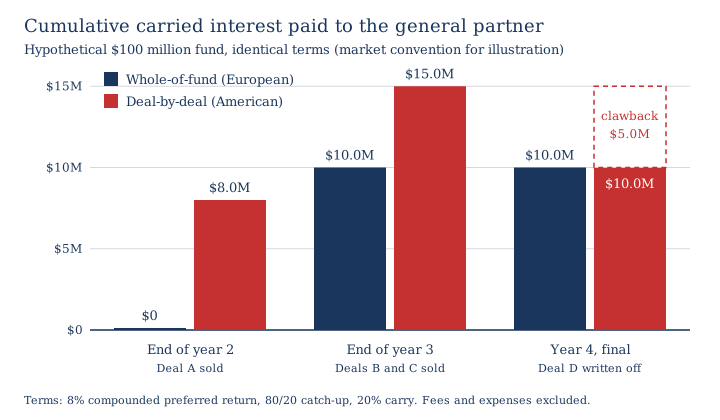
Timing runs in both directions. Under the European waterfall, limited partners hold $70,000,000 at the end of year two and $140,000,000 at the end of year three. Under the American waterfall they hold $62,000,000 and $135,000,000 at the same dates, and the final $5,000,000 depends on the general partner repaying it.
03The Clawback
The ILPA deal-by-deal term sheet sets a final clawback. If, at liquidation, the general partner has received more carry than it should have, or a limited partner has received less than its capital contributions plus preferred return, the general partner must contribute the lesser of two amounts: the greater of the excess and the shortfall, and the carry it received less taxes paid or payable on it. In the example the excess is $15,000,000 less $10,000,000, or $5,000,000, and there is no shortfall, because limited partners had already cleared the hurdle. The tax limit would bind only if taxes paid on the $15,000,000 exceeded $10,000,000.
ILPA Principles 3.0 set a stricter standard: clawback amounts should be gross of taxes paid and repaid no later than two years after the liability is recognized. Where gross-of-tax repayment is impractical, the hypothetical tax rates applied should reflect the actual marginal rates of the general partner's members. The Principles also call for escrow of 30 percent of carry distributions or more, and they encourage joint and several liability of the individual members of the general partner. In the example, a 30 percent escrow on $15,000,000 would hold $4,500,000, enough to cover 90 percent of the overpayment while the escrow is in place.
An interim clawback is the earlier test. The ILPA deal-by-deal term sheet runs one at the first anniversary of the end of the commitment period and annually after that, on removal of the general partner, and on any limited partner giveback, each time as a hypothetical final distribution at the general partner's valuation.
Because Deal D was carried at cost until it failed, an interim test before year four would have found nothing to return. ILPA Principles 3.0 address that gap by asking that, in a deal-by-deal waterfall, unrealized investments be valued at the lower of cost or market and that partial impairments and write-offs be made up continuously. K&L Gates, writing in the 2021 ILPA report, observes that many interim clawbacks occur only once or twice and often too late in the term.
The whole-of-fund waterfall does not remove clawback risk, but it reduces it. The 2021 ILPA report notes that the risk of overpaid carry is much lower in whole-of-fund structures, and the Principles state that an all-capital-back structure is the best approach to minimizing clawback liabilities.
04Section 1061 and the Holding Period
Carried interest is usually held as a profits interest, a partnership interest other than a capital interest. Under Rev. Proc. 93-27, as clarified by Rev. Proc. 2001-43, the Internal Revenue Service generally does not treat receipt of a profits interest for services as a taxable event, subject to stated exceptions. Character on the back end is governed by section 1061 of the Internal Revenue Code, added by Public Law 115-97.
26 U.S.C. 1061(a) treats as short-term capital gain the excess of a taxpayer's net long-term capital gain on an applicable partnership interest over the same gain computed with "3 years" substituted for "1 year" in the holding-period rules of section 1222, notwithstanding section 83 or any section 83(b) election. An applicable partnership interest is one transferred to or held by the taxpayer in connection with substantial services in an applicable trade or business (section 1061(c)(1)). Interests held by a corporation are excluded, as are capital interests that share in partnership capital commensurate with the capital contributed (section 1061(c)(4)).
The final regulations, T.D. 9945, 86 FR 5452, fix the relevant holding period as the direct owner's holding period in the asset sold, and they exclude section 1231 gain, section 1256 gain and qualified dividends from the calculation (26 CFR 1.1061-4(b)(7) and (b)(8)).
The waterfall therefore does not move the three-year line. In the example, Deal A was held two years and Deals B and C three years, none of them more than three. Under either waterfall, every dollar of carry traces to an asset that fails the three-year test, so the general partner's share of that gain is generally recharacterized as short-term. The American waterfall delivers $8,000,000 of that carry a year earlier; it does not change its character.
The 2025 budget reconciliation act, Public Law 119-21, enacted July 4, 2025, contains no amendment to section 1061, and a Kirkland & Ellis alert of July 14, 2025 states that the act does not change the tax treatment of carried interest. The three-year rule stands as the final regulations apply it. Section 1061 bears on the general partner's after-tax result, not on the limited partners' capital interests.
05The Life Sciences Portfolio
Deal D is not a tail case in healthcare. The Biotechnology Innovation Organization, Informa Pharma Intelligence and QLS Advisors put the likelihood of approval for a candidate entering Phase I at 7.9 percent over 2011 to 2020, with Phase II the hardest transition at 28.9 percent, and an average of 10.5 years from Phase I to approval (BIO, Clinical Development Success Rates 2011 to 2020). Growth-stage companies carry less of that risk than early clinical programs, but a regulatory decision, a coverage determination or a failed pivotal trial can still take a holding to zero years after a portfolio's first exit.
That sequence, early winners followed by a late write-off, is the pattern in which the two waterfalls diverge most. An allocator comparing two healthcare growth equity managers on the same 8 percent and 20 percent terms is comparing different contracts if one runs deal by deal. The terms that decide the outcome are specific and checkable:
- Waterfall unit. Whole-of-fund, deal-by-deal, or a hybrid that switches between them.
- First-tier scope. Whether a deal-by-deal first tier returns realized losses, unrealized losses and fees and expenses to date, or only the cost of the deal sold.
- Valuation basis. Whether unrealized investments are held at the lower of cost or market for the carry test.
- Escrow. The percentage withheld from carry and the release condition.
- Clawback terms. Gross or net of tax, the repayment period, and whether individual members guarantee it jointly and severally.
- Interim clawback triggers. Their dates, frequency and valuation basis.
- Hurdle definition. Whether the preferred return compounds on unpaid amounts or stops accruing once capital is returned, a distinction the 2021 ILPA report flags.
Each of those terms changes the dollars in Table 1 without changing the headline rates. Reading them is how an allocator tells two funds with identical cover terms apart.
06Frequently asked questions
What is the difference between a European and an American waterfall?
A European, or whole-of-fund, waterfall returns all contributed capital and the preferred return across the whole portfolio before the general partner receives carried interest. An American, or deal-by-deal, waterfall applies the tiers to each realized investment, so carry can be paid on an early winner before later investments are tested.
Does an American waterfall pay the general partner more in total?
Not if the clawback is enforced in full. In the hypothetical $100 million fund, the deal-by-deal waterfall paid $15,000,000 by year three against a whole-fund entitlement of $10,000,000, and a $5,000,000 final clawback brought the total back to $10,000,000. The difference lies in timing and in the risk that the clawback is limited by taxes or goes unpaid.
Does the waterfall type change the section 1061 holding period?
No. Under 26 CFR 1.1061-4(b)(8), the relevant holding period is the direct owner's holding period in the asset sold. A deal-by-deal waterfall can pay carry earlier, but gain from an asset held three years or less is generally recharacterized as short-term under either structure.
Nothing in this piece is investment, legal, tax or accounting advice, and nothing in it is an offer to sell or a solicitation of an offer to buy any security.
Three decades of operational leadership across agriculture, pharmaceuticals, biotechnology, climate, food and defense. He has spent that career doing the work this seat requires: strategic partnerships, licensing and business development, executed transaction by transaction. He sits with a company as an operating partner and a growth strategist rather than as a name on its board. A corporate finance and intellectual property attorney, an INSEAD MBA, and a former Air Force officer in aerospace. He also brings strong private equity experience.