The Term Sheet Guide for Life Sciences and Healthcare Founders
Term sheets carry more weight than the valuation headline. This guide walks life sciences and healthcare founders through the economic terms, control terms, and sector-specific issues to watch.
 By Peleg Chevion, Managing Partner
17 min read · Finance
By Peleg Chevion, Managing Partner
17 min read · Finance
In this note07 · 17 min
A term sheet runs a few pages, and most founders read it for one number. The pre-money valuation gets the attention. The clauses underneath it decide who gets paid first, who can block a decision, and what happens to the company when a clinical program slips a year. This is the term sheet explained from the founder's side of the table, with the life sciences and healthcare issues that generic venture guides leave out: capital released in tranches against regulatory events, university license terms that ride along into the financing, and consent rights that reach into your pipeline strategy.
The fine print carries more weight when capital is uneven. Cooley reported that down rounds rose to 12.1% of the venture financings it handled in the second quarter of 2026, in a quarter that also set a record for invested capital in the history of its report (Cooley, Q2 2026 Venture Financing Report). The same report counted 27 life sciences deals and $1.1 billion of invested capital, down from 32 deals and $1.8 billion in the first quarter. The PitchBook-NVCA Venture Monitor said the overwhelming majority of invested capital went to AI companies (PitchBook-NVCA Venture Monitor). When capital concentrates elsewhere, the terms a life sciences founder accepts do more to shape the outcome than a few points of valuation.
01 Why the term sheet matters more than the headline valuation
Price is one input to a payout function. Two offers at the same pre-money valuation can hand founders very different proceeds, because the preference, the anti-dilution formula and the option pool change what that price really buys. The practical discipline is simple: before comparing offers, model what common stockholders receive at three exit values. Pick one below the post-money valuation, one near it, and one strong outcome. Most of the damage from a bad term shows up in the first case, and that is the case a single-asset company faces if its lead program disappoints.
It also helps to know what you are signing. The economic and governance terms are typically non-binding and for discussion. The binding pieces are often ancillary: confidentiality, exclusivity, choice of law and expenses (Harvard Law School Forum on Corporate Governance). A Cooley partner writes that it is common for the only binding part of a term sheet to be a promise not to talk with other investors for a period after signing, and that 30 to 45 days is enough to finalize a venture investment in almost all cases (Cooley GO). Under Delaware law, a definitive agreement does not replace the binding provisions of a term sheet unless it contradicts them or says they no longer bind, so a confidentiality or exclusivity clause can outlive the closing (Harvard Law School Forum on Corporate Governance).
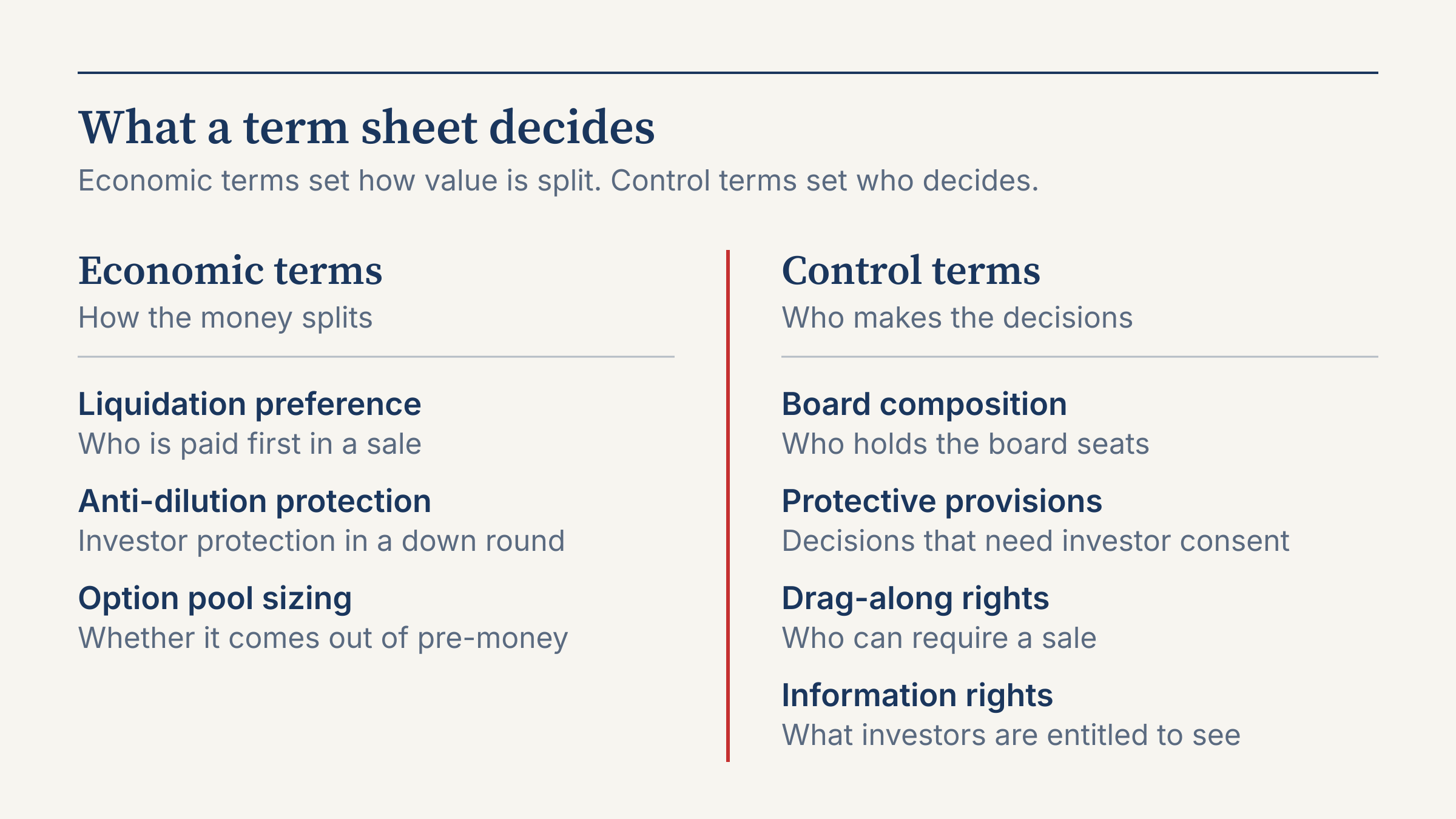
Learning how to read a term sheet starts with sorting every clause into one of two groups. Economic terms decide how proceeds are divided. Control terms decide who approves, blocks or forces the decisions that produce those proceeds. Every clause below lands in one column or the other, and most negotiating mistakes come from spending leverage in the wrong one.
02 Economic terms founders must understand
Liquidation preference. A liquidation preference lets preferred stockholders recover their investment before common stockholders if the company is sold, goes bankrupt or otherwise liquidates. Non-participating preferred receives the greater of an agreed multiple of its investment or what its shares would be worth converted to common. Participating preferred receives its multiple and then also shares pro rata with common. Capped participation sits between the two (Morrison Foerster ScaleUp). The founder-friendly version is also the market norm: in Cooley's second-quarter 2026 data, 95.8% of deals carried a 1x preference and 96.4% used nonparticipating preferred stock (Cooley).
Read the definition of what triggers the preference, not only the multiple. The NVCA model certificate of incorporation treats a merger and a sale, lease, transfer, exclusive license or other disposition of all or substantially all of the company's assets as a Deemed Liquidation Event (NVCA Model Certificate of Incorporation, October 2025). For a single-asset biotech, an exclusive worldwide license of the lead program can be economically a sale of the company, and the preference runs on that deal.
A worked example shows why the structure matters most in modest outcomes. Assume an investor puts in $30 million for 30% of a company at a $100 million post-money valuation, and every other share is common.
- Sale at $60 million, 1x non-participating: the investor takes the greater of $30 million or 30% of $60 million ($18 million), so $30 million. Common receives $30 million.
- Sale at $60 million, 1x participating: the investor takes $30 million, then 30% of the remaining $30 million, for $39 million. Common receives $21 million.
- Sale at $300 million: non-participating converts and takes $90 million, leaving common $210 million. Participating takes $30 million plus 30% of $270 million, or $111 million, leaving common $189 million.
The decision rule falls out of the math: a 1x non-participating holder converts once the sale price exceeds the post-money valuation at which it invested, and below that price the preference acts as a floor. As rounds accumulate, add up every series' preference. For non-participating preferred, that sum is roughly the sale price below which common receives nothing. The NVCA model pays series pari passu, meaning on equal footing, and most companies start that way (Morrison Foerster ScaleUp).
Anti-dilution protection. Anti-dilution adjusts the price at which preferred converts into common if the company later sells shares at a lower price. The NVCA model's weighted average formula is CP2 = CP1 × (A + B) ÷ (A + C). CP1 and CP2 are the conversion prices before and after the new issuance. A is the common stock outstanding before the issuance, counting options and convertible securities as outstanding. B is the number of shares the new money would have bought at CP1. C is the number of shares actually issued. Counting options and convertibles in A is what makes the formula broad-based. A narrow-based version shrinks A and produces a larger adjustment for investors (AngelList). Full ratchet recalculates conversion by dividing the original preferred price by the new, lower price, and it is far less common in U.S. venture deals than broad-based weighted average (Cooley GO).
The gap between the two is large. Suppose 20 million shares are outstanding on a fully diluted basis and a Series A investor bought 5 million shares at $2.00 for $10 million. The company then raises $15 million at $1.50. B is 7.5 million shares and C is 10 million shares, so the new conversion price is $2.00 × 27.5 ÷ 30, or about $1.83. The Series A now converts into about 5.45 million common shares. Under full ratchet the conversion price drops to $1.50, and the same investment converts into about 6.67 million shares, about 3.7 times the extra shares. The Holloway guide calls broad-based weighted average "absolutely customary" and ratchet-based anti-dilution "very atypical" (Holloway). A full ratchet in a life sciences term sheet is a signal about how the investor expects the next round to price.
Check the exemptions as closely as the formula. Anti-dilution clauses typically exempt employee stock options, shares issued in acquisitions and venture debt financing (Holloway). Life sciences companies should also make sure that equity issued to a university licensor or a strategic pharma partner sits on the exempt list, or a routine partnership can trigger an adjustment.
Option pool sizing. Investors often require the company to refresh the option pool to a target, often 10% to 15% of fully diluted capitalization, and to count it in the pre-money valuation (Holloway). Cooley's negotiating advice puts it plainly: understand the effect of including the pool in the fully diluted pre-money valuation (Cooley GO). Take a $40 million pre-money with $20 million of new money and a $60 million post-money. If the investor wants a 15% unallocated pool after closing, created inside the pre-money, $9 million of value comes out of existing holders, and their effective pre-money is $31 million. If a hiring plan supports 9%, the pool costs $5.4 million and the effective pre-money is $34.6 million. The better answer to "what size pool" is the hires you expect over the next 12 to 24 months, priced out, not a round number.
Terms that appear in later rounds. A Series C term sheet uses the same building blocks, but it adds a question about where the new money sits in the preference stack. A new lead may ask for seniority over earlier series instead of pari passu treatment. Some rounds add redemption rights or accruing dividends, which appeared in 5.4% and 3% of Cooley's second-quarter 2026 deals (Cooley). Pay-to-play provisions, present in 8.4% of those deals, require existing preferred holders to buy their pro rata share of a future round or have some or all of their preferred converted to common or a junior class (Morrison Foerster). The Holloway guide describes pay-to-play as common in biotechnology and life sciences deals because those companies need so much capital to reach the market (Holloway). For founders, a pay-to-play clause can be useful, because it forces insiders to support the company or give up their preferred status. Growth-stage investors also diligence differently, as covered in our guide to how growth equity firms evaluate AI healthcare companies.
03 Control terms founders must understand
Board composition. A typical board after an initial equity financing has three seats: one investor representative and two founders (Cooley GO). When later rounds add investor seats, the swing vote often becomes the independent director. Negotiate who nominates that seat and who must approve the choice. An independent director approved by both the common and preferred directors keeps the board from tipping to one constituency, and a clinical-stage company benefits from an independent with drug development or regulatory depth. If an investor proposes placing an operating partner on the board, ask what that person will actually do; the role has changed a great deal, as we describe in our look at how the operating partner role has evolved.
Protective provisions. These are veto rights held by preferred stockholders over specified corporate actions. The NVCA model lists actions that require consent of the Requisite Holders, including any liquidation or Deemed Liquidation Event, amending the charter in a way that adversely affects the preferred, creating stock senior to the preferred (or, in a bracketed option, on par with it), changing authorized shares, and paying dividends or redeeming stock. Bracketed options add changing the number of directors, debt above a threshold, new equity plans, loans and guarantees (NVCA Model Certificate of Incorporation). Some term sheets go further. The Holloway guide's list includes licensing away the company's IP (Holloway). For a therapeutics or diagnostics company whose financing strategy runs through regional partnerships and out-licensing, that consent right is a veto over the business model. Carve out non-exclusive and ordinary-course licenses, set thresholds that match the budget the board already approved, and ask for all preferred to vote as a single class rather than series by series, so each new round does not add another party with a veto.
Drag-along rights. A drag-along lets the majority holders force minority stockholders to join a sale. Founders often resist because investors holding a liquidation preference can approve a sale that works for them and not for common (Cooley GO). Reasonable asks: the drag applies only if the board and a majority of common also approve; proceeds are distributed according to the charter waterfall; founder indemnity exposure is several, not joint, and capped at proceeds received; and no founder must sign a new non-compete as a condition of the sale.
Information rights. Major Investors typically receive annual financial statements within 90 to 180 days of year-end, unaudited quarterly statements within 45 days, and a board-approved budget before each fiscal year (Morrison Foerster ScaleUp). These are market standard and rarely worth a fight. Spend attention on the Major Investor threshold, on excluding privileged material and trade secrets, and on what happens when an investor also holds a position in a competing program.
04 Life-sciences-specific term sheet issues
Milestone-based tranches. Tranched rounds are not an edge case in this sector. In Cooley's second-quarter 2026 data, 29.6% of life sciences venture financings were structured in tranches, up from 28.1% in the first quarter (Cooley). In its October 2, 2025 update, the NVCA formally addressed milestone-based financings in the model stock purchase agreement, including optional language that converts a non-funding investor's preferred into common (Foley and Lardner). The model defines the tranche condition as either a board determination that the milestones were achieved, including approval by the preferred directors and, in a bracketed option, the requisite purchasers, or a written waiver by the requisite purchasers "in their sole discretion." It also lets purchasers buy their tranche shares early in elective closings (NVCA Model Stock Purchase Agreement, October 2025).
That structure gives founders four places to negotiate:
- Write milestones that a third party could verify. "IND submitted" and "IND in effect" are different events. Under FDA regulations an IND goes into effect 30 days after FDA receives it unless FDA imposes a clinical hold, or earlier if FDA says the trial may begin (21 CFR 312.40). "First patient dosed in a Phase 2 trial" is objective; "positive Phase 2 data" invites argument about what positive means.
- Match the deadline to the biology. FDA describes Phase 2 as running several months to two years and Phase 3 as one to four years (FDA). A tranche with a 12-month drop-dead date on a readout that realistically takes 20 months is a down round on a timer.
- Name the device pathway precisely. A 510(k) shows substantial equivalence to a predicate device, De Novo classifies a novel device that has no predicate, and a PMA is the most stringent submission and applies to Class III devices. A clinical study may also require FDA approval of an Investigational Device Exemption first (FDA). A milestone that says "FDA approval" for a product on the 510(k) pathway is drafted around the wrong FDA decision.
- Price the option you are giving away. A second tranche at the first tranche's price is a call option for the investor: if the milestone hits, they buy at yesterday's price. Ask for a step-up, a smaller committed tranche, or the right to raise the balance from new investors if the tranche investors decline. Ask your auditors early, too: tranche rights can be a liability revalued each period, which creates large non-cash swings in reported results (BPM).
IP assignment and university licenses. For a spinout, the license agreement is part of the capital structure. The NVCA hosts a sample life science license agreement built on the US-BOLT university startup term sheet (NVCA). Its template gives the university common stock equal to a set percentage on a fully diluted basis, either at signing or at the next equity financing. It includes development milestone payments on events such as the first IND submission, dosing in Phase 1, 2 or 3 trials, FDA approval and first commercial sale. Its diligence milestones can include raising a minimum amount of financing by a set date, with extensions available for a fee. It permits assignment of the license in a change of control, and it makes the grant subject to U.S. government rights under Title 35 (US-BOLT Sample License Agreement).
Each of those clauses touches the term sheet. A financing deadline in the license shifts leverage to the investor if the term sheet's exclusivity window runs past it. Equity promised to the university at the next round has to be in the pre-money capitalization the investor is pricing. And federally funded inventions carry obligations investors will diligence: the funding agency's march-in right to require a license if the licensee has not taken effective steps toward practical application (35 U.S.C. 203), and the requirement that an exclusive U.S. licensee agree to substantially U.S. manufacture unless the agency grants a waiver (35 U.S.C. 204). Before the term sheet arrives, confirm that every founder, employee and consulting faculty member has assigned inventions to the company, and that the license covers the claims your lead program actually practices.
Regulatory triggers and covenants. Regulatory events can appear in more places than the tranche schedule. Watch for a clinical hold that suspends an investor's funding obligation, a regulatory milestone that shifts a board seat, a consent right over starting or stopping a trial, and redemption or dividend terms that begin to run if an approval slips. Ask that a clinical hold which is resolved within a defined period does not change any investor right, and that decisions about trial design stay with the board rather than a class vote.
05 How to negotiate a term sheet without blowing up the deal
Cooley's advice is to pick about three issues that matter and focus on those (Cooley GO). The market data makes the choice easier. A 1x non-participating preference and broad-based weighted average anti-dilution are the norm, so if a term sheet offers them, accept them and spend your leverage elsewhere. If it offers participation, a multiple above 1x, or a full ratchet, that is where the negotiation belongs.
Usually negotiable: option pool size backed by a hiring plan, the independent board seat, the scope and thresholds of protective provisions, tranche milestone definitions and deadlines, drag-along conditions, and the length of exclusivity. Rarely worth fighting: standard information rights for Major Investors and the basic form of the NVCA model documents, which the NVCA describes as the industry-embraced models for venture capital financings (NVCA).
Using a second term sheet. Leverage exists before you sign, because exclusivity binds after. Run investor conversations on a timeline that brings offers in together, and use a competing offer on the one or two terms that change proceeds rather than squeezing the last point of valuation. A signed term sheet's binding confidentiality clause may bar you from showing its terms to anyone else, so describe the competing offer rather than forwarding it. Evaluate the investor as well as the paper; our guide to how founders should evaluate emerging growth equity managers covers track record, fund economics and how much of their own capital the general partners commit.
When to bring in counsel. Before you sign the term sheet, not after. Once the exclusivity clock starts, the economics are set and the definitive documents mostly follow the term sheet. Choose financing counsel who has closed life sciences rounds and ask them to model the waterfall and read the license agreement alongside the term sheet. Counsel will also keep the securities mechanics clean. If the round relies on Rule 506(b), the exemption bars general solicitation, allows no more than 35 non-accredited purchasers, and requires a Form D filing within 15 days after the first sale (SEC). Promoting an open round publicly can put that exemption at risk.
06 A founder's term sheet checklist
- What do common stockholders receive at a sale below the post-money, near it, and at a strong outcome, with every series' preference stacked?
- Is the preference 1x and non-participating, and does the Deemed Liquidation Event definition cover an exclusive license of the lead asset?
- Is anti-dilution broad-based weighted average, and are university, strategic partner and lender equity exempt?
- Is the option pool inside the pre-money, and does its size match a 12- to 24-month hiring plan?
- Who nominates and approves the independent director, and how does the board change at the next round?
- Do the protective provisions reach licensing, partnering or trial decisions, and does preferred vote as one class?
- Does the drag-along require approval from common, cap founder liability and follow the charter waterfall?
- For each tranche: is the milestone objective, is the deadline realistic, who confirms achievement, and what happens if an investor does not fund?
- Does the university license contain a financing deadline, equity at the next round, or assignment limits that affect this round?
- Which clauses are binding, how long is exclusivity, and has counsel read the term sheet before you sign?
07Frequently asked questions
What is a term sheet in venture capital?
A term sheet is a short document that sets out the proposed terms of an investment before lawyers draft the definitive agreements. It covers economics, such as price, liquidation preference, anti-dilution and the option pool, and control, such as board seats, protective provisions and drag-along rights. Most of it is non-binding, but it sets the framework the final charter, stock purchase agreement and investor agreements will follow.
Is a term sheet legally binding?
Mostly not. The economic and governance terms are typically non-binding, but ancillary provisions usually bind: confidentiality, exclusivity or no-shop, choice of law and expenses. Under Delaware law, those binding provisions can survive the signing of definitive agreements unless the later documents contradict them or state that they no longer apply. Read the exclusivity period closely, because it ends your ability to negotiate with other investors.
What is a liquidation preference and why does it matter?
A liquidation preference lets preferred stockholders recover a set multiple of their investment before common stockholders in a sale, merger, exclusive license of substantially all assets, or wind-down. With 1x non-participating preferred, the investor takes the greater of its money back or its as-converted share; participating preferred takes both. The difference is largest in modest exits, so founders should model payouts at several sale prices.
How do I negotiate a term sheet as a life sciences founder?
Choose the few terms that change outcomes and spend leverage there: option pool size backed by a hiring plan, the independent board seat, the scope of protective provisions, and objective tranche milestones with realistic deadlines. Accept market-standard terms such as a 1x non-participating preference and broad-based weighted average anti-dilution. Negotiate before signing, because the exclusivity clause usually binds once you do.
What is a Series C term sheet and how is it different?
A Series C term sheet uses the same building blocks as earlier rounds, but the negotiation shifts to how the new money sits against the existing preference stack. Expect questions about seniority versus pari passu treatment, and sometimes redemption rights, accruing dividends or pay-to-play provisions. Earlier series may also hold consent rights, so more parties may need to approve the new round.
What life-sciences-specific terms should founders watch for?
Watch for tranches that release capital only after clinical or regulatory milestones, and confirm each milestone is objective, has a realistic deadline, and states what happens if an investor does not fund. Review how university license terms interact with the round, including licensor equity, financing deadlines and assignment on a sale. Check whether protective provisions give investors a veto over out-licensing your IP.
Where can founders find model venture financing documents to benchmark a term sheet?
The National Venture Capital Association publishes free model legal documents used in venture financings, including the certificate of incorporation, stock purchase agreement, investors' rights agreement, voting agreement, and right of first refusal and co-sale agreement. It also hosts life science licensing materials, including a sample university license agreement. Reading the model charter shows what a term sheet's shorthand becomes in the final documents.
Nothing in this piece is investment, legal, tax or accounting advice, and nothing in it is an offer to sell or a solicitation of an offer to buy any security.
Three decades of operational leadership across agriculture, pharmaceuticals, biotechnology, climate, food and defense.