Funding the Longevity Economy: A Growth Capital Guide for Longevity and Neuro Founders
Longevity and neuro science is harder for generalist investors to underwrite. This guide walks founders through the validation, regulatory, and data questions growth-stage capital will ask.
 By Peleg Chevion, Managing Partner
15 min read · Healthcare & Life Sciences
By Peleg Chevion, Managing Partner
15 min read · Healthcare & Life Sciences
In this note07 · 15 min
- What counts as the longevity economy
- Why this category is attracting growth-stage capital
- The scientific validation problem investors will press on
- Regulatory pathways for longevity and neuro therapeutics and devices
- How to build a fundable data package
- What growth-stage investors want to see before writing a check
- Frequently asked questions
Founders building in the longevity economy tend to discover the same thing at the growth stage: capital is available, but few investors can underwrite what they are buying. A company developing a therapy against the biology of aging, a biomarker of biological age, or an implanted neural interface is asking an investor to price scientific and regulatory risk with almost no history behind it. Regulators including the FDA, the EMA and Health Canada do not classify aging as a disease, so there is no approved product that "treats aging" to anchor a valuation.
That gap is where rounds stall. A generalist growth investor reads a mechanism story, cannot map it to an endpoint, a pathway and a payer, and passes. A specialist reads the same deck and asks narrower questions: which biomarker, validated for what, accepted by whom, reimbursed how. This guide works through those questions in the order diligence usually takes them, so the answers are in the data room before the first partner meeting.
01What counts as the longevity economy
The longevity industry uses the term loosely, stretching it from senescence drug programs to collagen supplements. Growth investors draw the boundary much tighter, and founders should too. Four segments sit inside it.
- Therapeutics that target aging biology. Programs aimed at mechanisms such as cellular senescence, mitochondrial decline or chronic inflammation. Because aging is not a recognized indication, these programs are developed and approved against a named disease in which the targeted mechanism drives the pathology.
- Diagnostics and biomarkers of biological age. Epigenetic clocks, proteomic panels and imaging measures that aim to estimate how fast a person is aging or to track response to an intervention. Their value depends entirely on what they have been shown to predict, and their commercial logic overlaps heavily with the wider precision medicine investment landscape.
- Neurotechnology devices. Implanted brain-computer interfaces, neuromodulation systems and neural sensing platforms. The FDA has had final guidance since May 2021 on nonclinical testing and on the design of feasibility and pivotal studies for implanted brain-computer interfaces for patients with paralysis or amputation.
- Brain-health digital therapeutics. Prescription software that treats or improves a neurological or cognitive function. A useful precedent is EndeavorRx, which the FDA classified on June 15, 2020 as a prescription device indicated to improve attention function in children ages 8 to 12 with primarily inattentive or combined-type ADHD.
What sits outside the boundary is consumer "anti-aging" wellness: supplements, lifestyle apps and wearables sold on general health claims. The distinction is not the technology. It is the claim. Under the FDA's general wellness guidance, issued January 6, 2026, a product counts as a low-risk general wellness product only if it is intended for general wellness use alone and presents a low risk to users; a product that is invasive or implanted fails the risk test. A product also stops qualifying if its labeling, advertising, user interface or functionality references specific diseases, clinical conditions or diagnostic thresholds, or claims clinical accuracy or medical grade. The same wrist sensor can be a wellness gadget or a regulated device depending on a sentence on the packaging.
Investors care about that line because companies that straddle it carry two risks at once: enforcement exposure if wellness marketing drifts into disease claims, and credibility damage if a clinical program shares a brand with products that have no evidence behind them.
02Why this category is attracting growth-stage capital
Longevity investing has moved from a niche thesis to a tracked asset class. Longevity.Technology, which describes its DLT platform as turning the global longevity landscape into a living dataset, reported in its 2024 Annual Longevity Investment Report that total financing reached $8.49 billion in 2024, up from $3.82 billion in 2023. The same release says longevity discovery platforms alone attracted more than $2 billion, later-stage ventures took around a third of all funding, and the United States was home to 57% of longevity companies and 84% of total deal volume.
Two details in those numbers matter more to a founder than the headline longevity market growth. First, capital concentrated in platforms and later-stage companies, so the bar for a growth round is set by the best-capitalized peers, not by the median seed deal. Second, the release gives two different deal counts for 2024 (331 in one passage, 325 in another). Sector statistics are still maturing, and a disciplined investor will build its own comparables rather than rely on the ones in your deck.
The broader healthcare market points the same way. Bain reports that healthcare private equity reached a record high in global deal value in 2025, with deal count at the second-highest annual total on record and provider and biopharma assets anchoring activity. Public money is moving too: in February 2026, ARPA-H announced that its PROSPR program is investing up to $144 million over five years across seven research teams working to detect and intervene on the earliest changes associated with aging.
Competition for attention is real, however. The PitchBook-NVCA Venture Monitor reports that U.S. startups raised more than $400 billion in the first half of 2026, with the overwhelming majority of invested capital flowing to AI companies. A longevity or neuro company is competing for the same partner hours. The stronger pitches show AI working inside the science, in biomarker discovery or patient selection, rather than AI presented as a separate story. The data-layer decisions behind that are covered in a companion piece on AI infrastructure for life sciences and healthcare founders.
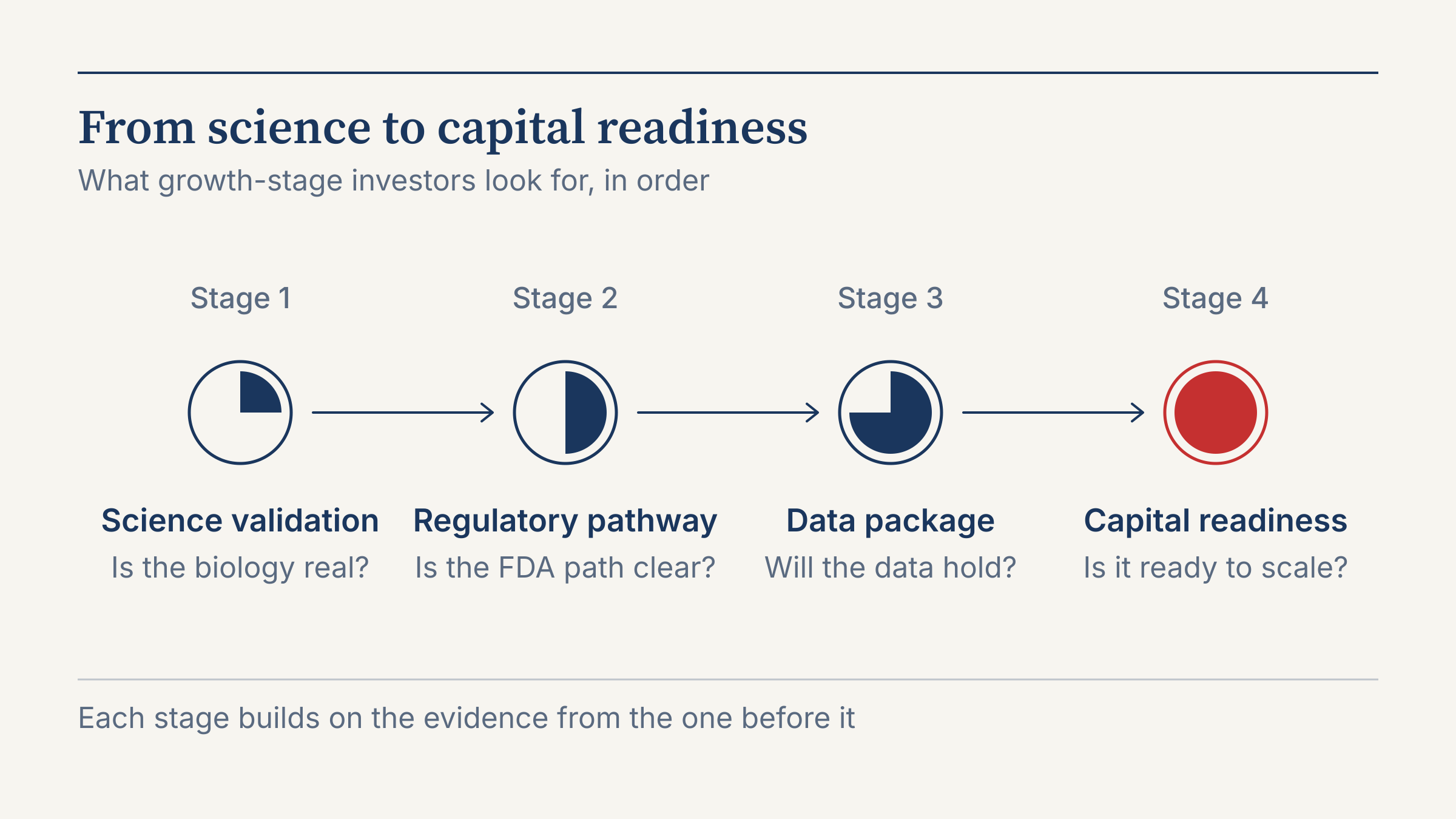
More capital does not lower the diligence bar. It raises it, because investors with more options can pass on any company that cannot answer four questions in sequence.
03The scientific validation problem investors will press on
Most therapeutic areas let investors borrow confidence from history. Oncology and cardiology have decades of outcome data to calibrate against. Aging biology does not. A 2025 scoping review in the Journal of Nutrition, Health & Aging notes that the FDA does not offer clear guidelines for therapies aimed at aging itself, which creates uncertainty in trial design and approval, and identifies the TAME trial as the only study the FDA has approved to investigate an intervention targeting multiple age-related diseases rather than a single condition.
TAME shows the scale of the problem. The trial is designed to study more than 3,000 people aged 65 to 79 at 14 research institutions over six years, measuring whether metformin delays the development or progression of age-related chronic diseases such as heart disease, cancer and dementia. Its organizers describe the goal as persuading the FDA to approve aging as an indication. Few venture-backed companies can fund a six-year, 3,000-person outcomes trial before they have revenue, which is why the field is working on shorter-horizon measures. ARPA-H's PROSPR program is aimed at protocols that can assess age-associated health outcomes in three years instead of decades, and at giving the FDA expert consensus recommendations on how intrinsic capacity might be measured and used as a clinical endpoint.
Until those tools mature, founders live on surrogate endpoints. The FDA defines a surrogate endpoint as a marker, such as a laboratory measurement, radiographic image or physical sign, that is thought to predict clinical benefit but is not itself a measure of clinical benefit. What investors care about is the grade. A validated surrogate is known to predict clinical benefit and could be used to support traditional approval; one that is only reasonably likely to predict benefit can support accelerated approval. Accelerated approval still requires studies to confirm the anticipated benefit, and if they fail, the FDA has procedures that could lead to removing the drug from the market.
Case study: the amyloid antibodies
Neuro founders have a recent and expensive example of what that grading means commercially. The FDA's surrogate endpoint table lists reduction in amyloid beta plaques as an accelerated-approval surrogate in Alzheimer's disease. Aduhelm received accelerated approval in June 2021. On April 7, 2022, CMS decided that anti-amyloid antibodies approved on a surrogate endpoint such as amyloid reduction may be covered in a randomized controlled trial conducted under an investigational new drug application, while those approved on a direct measure of clinical benefit may be covered in CMS-approved prospective comparative studies. In January 2024, Biogen announced it would discontinue the development and commercialization of Aduhelm, stated that the decision was not related to any safety or efficacy concerns, and returned the rights to Neurimmune.
Leqembi took the other route. It received accelerated approval on January 6, 2023, and traditional approval on July 6, 2023, based on the Phase 3 Clarity AD trial, in which treatment reduced clinical decline on the CDR-SB scale by 27% at 18 months compared with placebo. The same day, CMS said broader Medicare coverage was now available, provided the treating clinician participates in a registry that collects real-world evidence.
The lesson is not about Alzheimer's biology. A biomarker can be sufficient for the FDA and insufficient for the payer, and the distance between the two can decide whether a product has a market. Investors will ask which rung your lead biomarker occupies today, what it would take to move it up, and who pays in the meantime.
04Regulatory pathways for longevity and neuro therapeutics and devices
Therapeutics
Because aging is not an indication, a longevity therapeutic needs a disease beachhead: a serious, named condition in which the targeted mechanism plausibly drives outcomes and for which regulators already accept an endpoint. Accelerated approval exists for drugs that treat serious conditions and fill an unmet medical need, but it carries the obligation to confirm clinical benefit. A growth investor will want the confirmatory trial budgeted in the financing plan, not deferred as a post-approval problem. Expansion from the first indication into adjacent age-related diseases belongs in the deck as upside, never as the base case.
Biomarkers
Companies whose product is a biomarker, or whose trials depend on one, have two routes. The first is formal qualification. A qualified biomarker has undergone a formal regulatory process so it can be relied on for a specific interpretation within a stated context of use, and it may then be used under that context of use in any CDER drug development program. That makes it a durable asset, and also one competitors can use. The second route is to justify the biomarker inside a single development program, which is narrower but stays under the company's control and has to be argued again for each new program. Investors will ask which route you have chosen and why.
Devices
For neurotechnology, the FDA's Breakthrough Devices Program is the most relevant accelerator. A device qualifies if it provides more effective treatment or diagnosis of life-threatening or irreversibly debilitating human disease or conditions and meets at least one secondary criterion: it represents breakthrough technology, no approved or cleared alternative exists, it offers significant advantages over existing alternatives, or its availability is in the best interest of patients. Designated companies can request sprint discussions, a discussion of their data development plan and a clinical protocol agreement, and they receive prioritized review of Q-Submissions, IDE applications and marketing submissions. The program applies to devices on the PMA, 510(k) and De Novo pathways.
Two cautions keep founders from overselling a designation. Breakthrough devices still must meet the FDA's standards for safety and effectiveness. And designation is not rare: as of June 30, 2026, CDRH and CBER had granted 1,320 Breakthrough Device designations. It shortens the conversation with the agency. It does not substitute for the evidence.
Digital therapeutics show how a first mover can build a pathway for everyone else. When the FDA granted the EndeavorRx De Novo request, it classified EndeavorRx and substantially equivalent devices of this generic type into Class II under a new regulation for digital therapy devices for ADHD. The first company carried the cost of creating the category; companies that later want to market the same device type submit a premarket notification rather than build a new classification from scratch.
Reimbursement
Authorization is the midpoint, not the finish. CMS's Transitional Coverage for Emerging Technologies pathway is open to FDA-designated Breakthrough Devices that fall within a Medicare benefit category and lack an existing national coverage determination. CMS aims to finalize a national coverage determination within six months after FDA market authorization, with an evidence development plan to close remaining gaps, but it anticipates accepting up to five candidates per year. A company whose revenue model depends on Medicare beneficiaries should model the scenario in which it does not win one of those slots. The same commercial discipline applies across advanced modalities, as the analysis of gene therapy commercial viability shows.
05How to build a fundable data package
A fundable data package answers the questions above before anyone asks them. In practice it has five components.
- An evidence ladder. One page that lists every scientific claim in the deck and the highest level of evidence behind it: in vitro, animal model, human target engagement, reasonably likely surrogate, validated surrogate, clinical outcome. It should show which claims the next round of capital moves up a rung. Investors will reconstruct this list themselves if you do not provide it, and it is better that yours is the one they start from.
- A biomarker validation strategy. For each biomarker, state what it measures reliably, what it has been shown to predict, whether it moves when the intervention works, and the context of use you intend to claim. An aging clock that tracks chronological age but has not been shown to respond to an intervention in a way that predicts outcomes is a research tool, not an endpoint.
- A regulatory map. The disease beachhead, the intended pathway, any designations, and a record of what the agency has said in pre-submission interactions. Written FDA feedback carries more weight in diligence than any advisor's opinion about what the FDA will accept.
- A reimbursement map. The payer, the benefit category, the coding and coverage route, and the evidence the payer will require beyond FDA authorization. The amyloid antibodies show why this belongs in the package from the start.
- A claims firewall. An inventory of every public claim made by the company, its founders and any affiliated consumer product, checked against the disqualifiers in the FDA's general wellness guidance: references to specific diseases or diagnostic thresholds, prompts that direct clinical action, and claims of clinical accuracy or medical grade. Diligence teams read websites and listen to podcasts. A founder describing a supplement line as reversing aging can undo a clean clinical data room.
AI belongs inside these components rather than beside them. Models trained on longitudinal biomarker data can shorten discovery and sharpen patient selection, but investors will test them the way they test any assay: which outcome the model predicts, on which cohort it was validated, and whether performance held on data it never saw during training. A model without outcome labels is a useful hypothesis generator. It is not evidence.
Finally, tie the use of proceeds to evidence milestones. Growth capital in this category buys movement up the ladder: a surrogate validated, a pivotal study enrolled, a coverage decision secured. A budget organized by department rather than by milestone tells an investor the company has not yet decided what the money is for.
06What growth-stage investors want to see before writing a check
The list below is what a specialist growth investor typically works through. None of it is exotic. The difference between a funded company and a stalled one is usually whether the answers already exist in writing.
- Scientific rigor. Peer-reviewed or independently replicated mechanism data, a biomarker strategy with a named context of use, and a candid account of what the data do not yet show.
- A disease beachhead. A first indication that is serious, named and measurable, chosen because an accepted endpoint exists rather than because the market looks largest.
- Regulatory clarity. A pathway, a designation status and written agency feedback, plus a budgeted confirmatory plan if the strategy relies on accelerated approval.
- A payer thesis. Who pays, under which benefit, on what evidence, and what happens to the plan if coverage arrives with evidence development conditions attached.
- A credible commercial model. Pricing logic, the sales channel (specialist physicians, health systems or direct prescription) and a realistic time from authorization to meaningful revenue.
- Clean separation from wellness claims. No public statement that reads as a disease claim for an unregulated product, and no brand overlap that lets a consumer line borrow the clinical program's credibility.
- A team fluent in both languages. Leaders who can defend the biology to a scientific advisor and the unit economics to an investment committee in the same meeting. A gap on either side tends to end a diligence process early.
The longevity economy will reward companies that treat the absence of long-term human data as a design constraint rather than a messaging problem. Founders who can show exactly which uncertainty the next dollar retires will find this category far easier to underwrite than its reputation suggests.
07Frequently asked questions
What is the longevity economy?
The longevity economy covers companies developing medical products aimed at the biology of aging and age-related decline: therapeutics that target aging mechanisms, diagnostics and biomarkers of biological age, neurotechnology devices, and brain-health digital therapeutics. It excludes consumer anti-aging wellness products sold on general health claims. Because the FDA does not classify aging as a disease, regulated longevity products are developed and approved against specific, named conditions.
Is longevity biotech a legitimate investment category or a fad?
It is an established and measurable category. Longevity.Technology reported $8.49 billion of longevity financing in 2024, up from $3.82 billion in 2023, and ARPA-H committed up to $144 million over five years to healthspan research in 2026. The science is younger than in most therapeutic areas, so investors scrutinize biomarker validation and regulatory strategy more heavily than they would in oncology or cardiology.
What regulatory pathways exist for neurotechnology devices?
Neurotechnology devices reach the U.S. market through premarket approval, 510(k) clearance or De Novo classification, depending on risk and whether a predicate device exists. Devices that offer more effective treatment or diagnosis of life-threatening or irreversibly debilitating conditions can seek Breakthrough Device designation, which adds sprint discussions and prioritized review but does not lower the safety and effectiveness standard. Implanted brain-computer interfaces also have dedicated FDA guidance, finalized in May 2021.
How do investors evaluate longevity science that lacks long-term human data?
They look for a credible bridge from mechanism to outcome. That means biomarkers with a defined context of use, evidence that the biomarker moves when the intervention works, and a clear view of whether it is a validated surrogate or only reasonably likely to predict benefit. Investors also expect a first disease indication with an accepted endpoint and a candid account of what current data cannot yet show.
What is the difference between anti-aging and longevity medicine investing?
Anti-aging usually describes consumer products such as supplements, apps and wearables marketed on general wellness claims, which the FDA does not intend to examine as devices when they stay low risk and avoid disease references. Longevity medicine means therapeutics, diagnostics and devices that target aging biology through a named disease indication and are built for FDA review. Investors value the first on consumer brand economics and the second on clinical and regulatory evidence.
When should a longevity or neuro company raise growth equity instead of venture capital?
Venture capital typically funds discovery and early mechanism work, when the main risk is whether the biology holds. Growth equity fits later, once a company has human biomarker or clinical data, a defined regulatory pathway and a first indication, and needs capital for pivotal trials, regulatory submissions or early commercialization. The practical test is whether the next dollar retires a scientific unknown or executes against evidence that already exists.
Nothing in this piece is investment, legal, tax or accounting advice, and nothing in it is an offer to sell or a solicitation of an offer to buy any security.
Three decades of operational leadership across agriculture, pharmaceuticals, biotechnology, climate, food and defense.